Boiler pressure drops when water escapes from the sealed central heating system. The cause may be a visible leak, a faulty component, or gradual seepage too small to spot. Topping up the pressure can restore normal function for a while, but it does not fix the underlying cause. This article examines the most common reasons pressure falls, how to identify which one applies to your system, and when the problem calls for a Gas Safe registered engineer rather than a DIY fix.
Key takeaways
- Healthy boiler pressure should sit between 1 and 1.5 bar at rest.
- Pressure below 0.5 bar triggers a lockout, while pressure above 3 bar risks relief valve discharge.
- If you need to top up every few weeks, that points to a minor leak rather than a one-off event.
- A failed expansion vessel membrane makes pressure rise and then drop during each heating cycle.
- Dry all visible pipework and valves, then check again after 24 hours to help locate leaks.
- Repeated top-ups dilute inhibitor and speed up sludge buildup in radiators and heat exchangers.
- Call a Gas Safe registered engineer if pressure drops more than once within a fortnight.
What Normal Boiler Pressure Looks Like and When to Act
Check your boiler’s pressure gauge before you assume a fault. A reading between 1 and 1.5 bar at rest indicates a healthy system, and it should rise to around 2 bar when the heating runs. These figures appear in your boiler manual and, for many common models, in a Boiler Fault Code Finder alongside related error codes.
Pressure below 0.5 bar typically triggers a low-pressure lockout. At above 3 bar, the pressure relief valve opens and releases excess water. This safety mechanism protects the system, but it also signals that the system needs attention. If the gauge consistently reads above 2.5 bar after topping up, the system is over-pressurised rather than in need of a simple refill.
Short-term pressure fluctuation during a heating cycle is normal. As the system cools, a drop of 0.3 to 0.5 bar is expected. If pressure falls below 1 bar within days of topping up, it warrants investigation rather than another top-up.
The Most Common Reasons a Boiler Loses Pressure
| Cause | Typical clue |
|---|---|
| Radiator valve gland nuts or pipework joints leaking | Pressure drops over time and water marks may appear around joints or under radiators |
| Faulty pressure relief valve (PRV) | Dripping discharge pipe or mineral staining even at normal pressure |
| Failed expansion vessel diaphragm | Pressure rises on heating, then falls as the system cools and the PRV may release water |
Pressure drops below 1 bar when water escapes from the sealed system. The loss may happen slowly through a small leak or suddenly after a component failure. If you need to top up every few weeks, that suggests a minor fault. If pressure drops overnight, an active leak is more likely.
Radiator valve gland nuts and soldered pipework joints are the most frequent causes. They often stay hidden behind radiators or under floors. This differs from what causes low water pressure in one shower only, which originates in the supply network rather than the sealed heating circuit.
A faulty pressure relief valve (PRV) may weep continuously even at normal pressure. Check the discharge pipe for dripping or mineral staining. If either is present, replace the valve.
If the expansion vessel’s rubber diaphragm perforates, the vessel fills with water. It can then no longer absorb pressure changes, which forces the PRV to release water on every heating cycle. A Gas Safe registered engineer can test vessel pre-charge pressure at the Schrader valve using a tyre gauge.
Hidden Causes That Top-Up Fixes Cannot Solve
Topping up the filling loop restores pressure, but it does not fix the cause. Repeated top-ups dilute inhibitor and add fresh oxygen, which speeds up sludge formation inside radiators and heat exchangers.
A faulty expansion vessel is a common cause. If its internal membrane fails or it loses its air charge, pressure rises during heating and drops as the system cools. The pressure relief valve then opens to compensate, releasing water and lowering the gauge. The vessel needs re-pressurising or replacing.
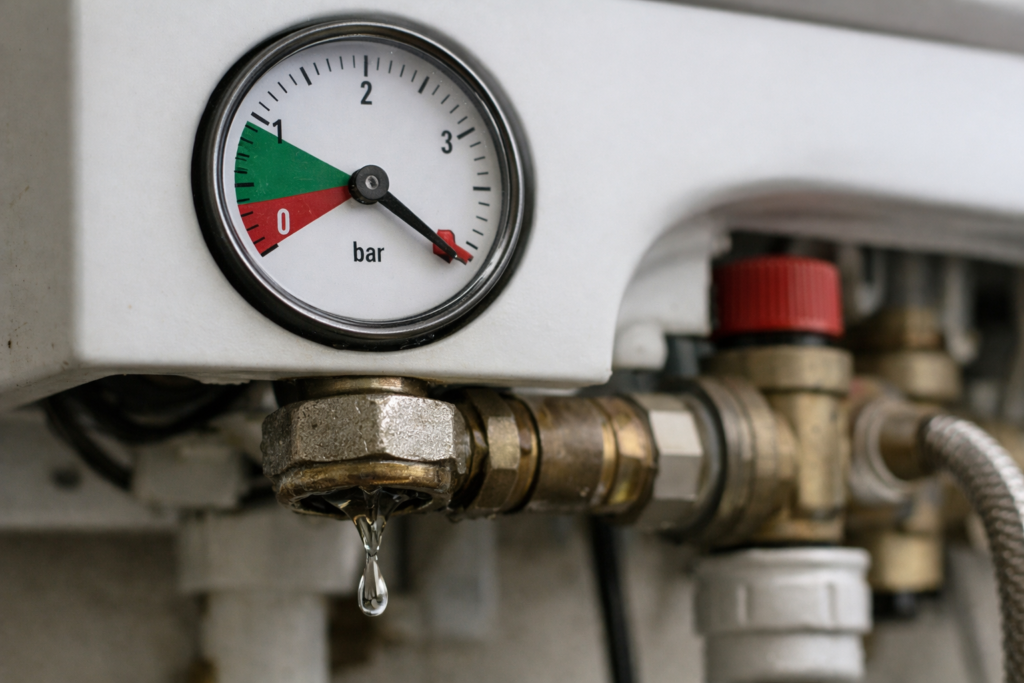
A weeping pressure relief valve can cause a similar pattern. During each heating cycle, it may discharge a small amount of water through the discharge pipe, so the loss is easy to miss. Check the discharge outlet for moisture or mineral deposits instead of relying on the gauge alone.
Both faults affect pressurised components and require a Gas Safe registered engineer. The Boiler Guide covers common failure points in detail. Fixing the underlying fault stops pressure loss at source.
How to Diagnose Whether You Have a Leak or an Internal Fault
A steady pressure drop over several days usually points to an external leak. A sharp overnight drop, or one that appears after heating and cooling cycles, suggests an internal fault such as a failed expansion vessel membrane or a weeping pressure relief valve.
Dry all visible pipework, radiator valves, and accessible joints. Then check each area again after 24 hours. Water marks, limescale, or corrosion around a joint confirm a slow leak. If every surface stays dry, the fault is likely internal.
Check the pressure relief valve discharge pipe. It typically exits through an outside wall. A drip or damp patch below it confirms that the valve is releasing water, either from over-pressure or a faulty seat.
To test the expansion vessel, attach a tyre pressure gauge to the Schrader valve while the system is cold and depressurised. Most residential vessels require 0.75 bar to 1 bar. A zero reading or water from the valve means the membrane has failed. A Gas Safe registered engineer can recharge or replace it.
If no external leak is visible and the vessel charge is correct, an engineer can isolate sections of pipework and monitor pressure decay to find the fault. Thermal imaging cameras can reveal leaks inside walls or beneath floors where physical inspection cannot reach.
When to Call a Gas Safe Engineer and What to Expect
If a boiler keeps losing pressure after diagnosis, topping it up will not fix the fault. Repairs to sealed heating components must be carried out by a Gas Safe registered engineer. Attempting these repairs without registration is illegal under Gas Safety Regulations and voids most warranties.
Book an engineer if the pressure drops more than once within a fortnight, if the pressure relief valve is visibly discharging water, or if the expansion vessel needs re-pressurising. These signs point to components that need testing or replacement, not routine maintenance.
The engineer will pressure-test the system, check the expansion vessel charge with a Schrader valve gauge, and inspect the pressure relief valve for weeping. A competent engineer will also identify whether the fault lies in the primary circuit or inside the boiler casing before quoting for parts.
Use the official Gas Safe Register postcode search to verify credentials beforehand, or hire a local plumber with Gas Safe registration. Ask the engineer to record the repair and pressure readings in your boiler service log. This helps support future warranty or insurance claims.
Frequently Asked Questions
Why does a boiler keep losing pressure after being topped up?
A persistent pressure drop usually points to a leak or a faulty component. Common causes include a leaking radiator valve, a weeping pipe joint, or a failing pressure relief valve that discharges water intermittently. If the pressure falls again within days of topping up, a heating engineer should inspect the system instead of repeated repressurising.
What pressure level is considered normal for a domestic boiler?
Most domestic boilers operate correctly at 1 to 1.5 bar when cold. As the heating runs and the water warms, pressure typically rises to around 2 bar. Readings that stay below 1 bar or above 2.5 bar indicate a fault worth investigating.
Can a leaking radiator or pipe cause boiler pressure to drop?
Check every radiator and any visible pipe for damp patches, rust stains, or corrosion. Even a slow weep from a valve or joint can lose enough water over time to pull pressure below 1 bar. Pinhole leaks inside walls are harder to spot, but they cause the same drop.
Does a faulty pressure relief valve lead to repeated pressure loss?
Yes, but the mechanism differs from a leak. A faulty pressure relief valve discharges water when pressure rises above its set threshold, typically 3 bar. If the valve seat wears, or debris stops it from reseating fully, small amounts of water can escape continuously. This causes gradual pressure loss without any visible pipe damage.
When should repeated boiler pressure loss be checked by a Gas Safe engineer?
Two or more pressure drops within a month usually point to a fault that topping up will not fix. A Gas Safe registered engineer can pressure-test the system, inspect the expansion vessel, and check for internal leaks. If the cause goes undiagnosed, it can lead to long-term damage to the heat exchanger and other components.